AnalogueBlog

Devil In The Details?

Seems that they tell me to generalize; that ‘anecdote is not data’. Or rather, that others, perhaps poor observers of the minutiae inherent to the world around them, follow that line of reasoning voluntarily, even unthinkingly. I simply can’t.

What the purpose of someone who commits her observations to print, if not to convey her most intimate perceptions? No hard news journalist (ever), I’m first and foremost a ruminator over what they used to call ‘the personal essay’ (always preceded by a reasonably clever title!). It shouldn’t be necessary to state what seems obvious to this crushed analogueist: the social media age has dramatically reduced writerly capacity (and permission) for deeply literate composition. That, I sincerely hope, will never be the case amongst these virtual pages.

Victorian authors were compensated for each and every word: the more, the merrier (and increasingly lucrative.) Hence the supernaturally romanced, malevolent and wry prose of Charlotte Brontë, whose Jane Eyre I consider the greatest single novel ever. But the penultimate example of that era’s verbosity is another hero of mine, Charles Dickens. Copious vocabulary dances around and frames his myriad settings and personages. And yet ironically, as I cite these two nineteenth-century legends, have any examples of their descriptive powers jumped so firmly into my mind that I’ve felt compelled to copy them herein?

Perhaps, over time, I myself have come to an acceptably modern crossroads: understanding that a veritable laundry list of identifiers is untoward, but a few carefully chosen ones are germane.
There’s Nothing Novel About This Coronavirus


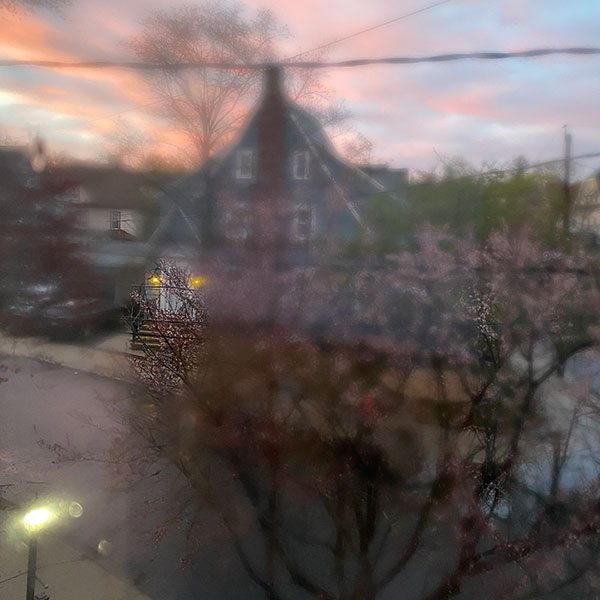
We’d been living this way since time immemorial, my attic-bound wraith of a friend and I, when the pandemic descended and countless newly-untethered folk joined our ranks in their own ungilded cages. There but for the grace of my deceased father’s affluence went my manic-depression and I, who otherwise would have been rotting clear away on America’s callous streets for decades. To be absolutely fair: this rented sliver of an Arts and Crafts homestead I occupied, a treehouse-like array of foyer and four small rooms united by two narrow staircases and adjoined by a second-level summer deck, was a veritable catalogue of my decorative imagination. The efflorescence of a New England spring now surrounded it. But then, its well-featheredness, achieved with all manner of colorfully old and lovely things, had been conceived expressly to soothe my ever-dissatisfied mind. Meanwhile, our omnipresent schadenfreude couldn’t help but run over just a tad before giving way to a lulling sense of absurdity at the abject foolishness of suddenly-hapless Americans. Folk like us had seen this coming, in some way, shape or form, for years. And involuntarily trained for it.

We knew unbidden isolation to be, in large part, sickeningly dull (and that in endless perpetuity, the dreary seasons and days especially.) It cannot often enough be stated and reiterated that the lives of the chronically-depressed; bipolar; obsessive-compulsive; schizophrenic; et alia (or any combination thereof) are ruined swiftly, and usually young. Only shreds of one’s ‘former existence’ can ever be recouped, a modicum of satisfaction and accomplishment salvaged – and every day will eternally dawn moodily different. My friend and I hoped that myriad others would begin to comprehend: our prisons, both the truly wretched and the relatively cushy, had never been voluntarily selected. So I reveled somewhat at now cresting (however tenuously, but with a well-earned feeling of security and confidence) that ever-fickle wheel of fortune, high atop which much refuge could be found.